 Skip to content

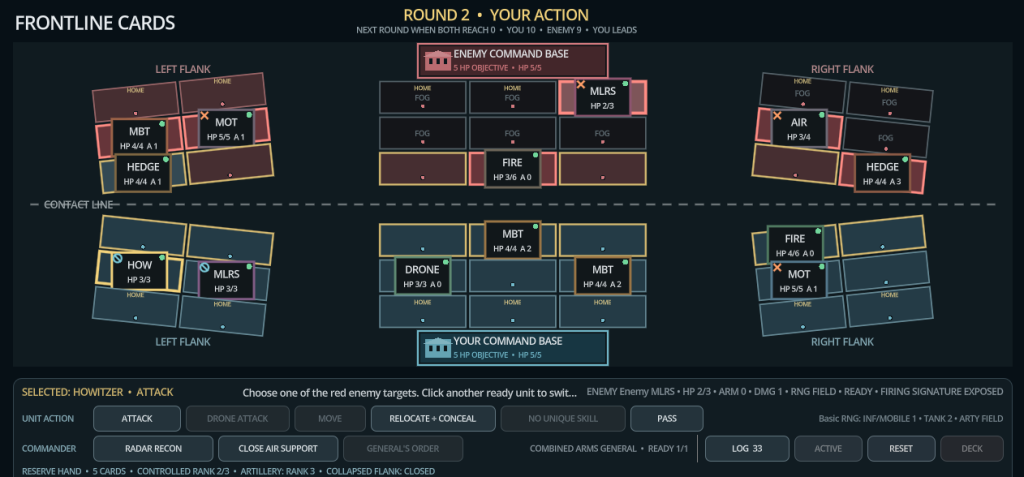
I’ve been working on this project quietly for some time, and it has finally reached the point where I can introduce it as a game rather than an experiment. I haven’t settled on a final name yet so let’s go with Project “Catgirls War III” for now, but I have more or less decided on identity and made a functioning core.
So, what is it?
A turn-based tactical card wargame with deckbuilding and visual-novel storytelling built on Godot engine. A compact battlefield, modern combined-arms tactics, and a story about a roster of anime catgirl commanders trying to win a war while the politics around it stop making sense.
The basic premise: the Catgirl Empire goes to war.
And I am not treating the war itself as a joke. The tone mixes dark “war is hell” military drama with dry, cruel institutional absurdity. I want that contrast to be part of the game’s identity: beautiful anime commanders with expressive cat ears exist alongside artillery bombardments, broken supply lines, desperate withdrawals, and orders written by people far removed from their consequences.
Visually, I’m aiming for detailed military-anime aesthetics. Uniforms, weapons and equipment should feel functional and believable while the characters stay pretty and expressive. The Catgirl Empire has its own fictional military identity, loosely mixing structured imperial officer tailoring with modern field gear. I am not using any real world country or military, but of course some references are unavoidable.
The war and the people fighting it
The planned campaign is twenty-something missions.
It begins as what looks like a quick’n’easy war, but as soon as politics takes priority over military goals, it escalates far beyond anything the catgirls anticipated. When truth is nowhere to be found and orders get harder and harder to explain as mere incompetence, what keeps us fighting is our soldiers, our country, and the simple fact that losing means the end of catgirls altogether.
Supreme Leader Nekoria kickstarts the story and her real intentions are as murky as her words are noble. While the smug chief of staff General Jeremiah is responsible for turning political decisions into military orders and money in her pockets.
The player follows several field commanders rather than one permanent protagonist. Aquilla Nyanwave is the disciplined combined-arms commander and the closest thing the group has to a moral center. Fenella Korsa is a cheerful artillery veteran who seems happiest while calculating where several tonnes of explosives should land. Mika Alphard handles drones and electronic warfare, watching enemies and allies with equal suspicion. Catalina Reo is a calm fortification specialist, the dependable adult in the room. Serena Kamen leads aggressive deep strikes, and Arisa Uno commands a private military force, but she cares far more about her country and her people than her mercenary reputation initially suggests.
Their personalities reflect their fighting style. Each commander represents a different military doctrine, fields unique units, and the missions built around them emphasize different decks, abilities and objectives.
Sadly, I’m not an artist, so my catgirls don’t exist yet even as rough sketches. I’m trying to save up and commission the art, so maybe in the next dev blog I’ll have something to show.
Cards that become an army
The central idea is simple: cards are actual military regiments and units.
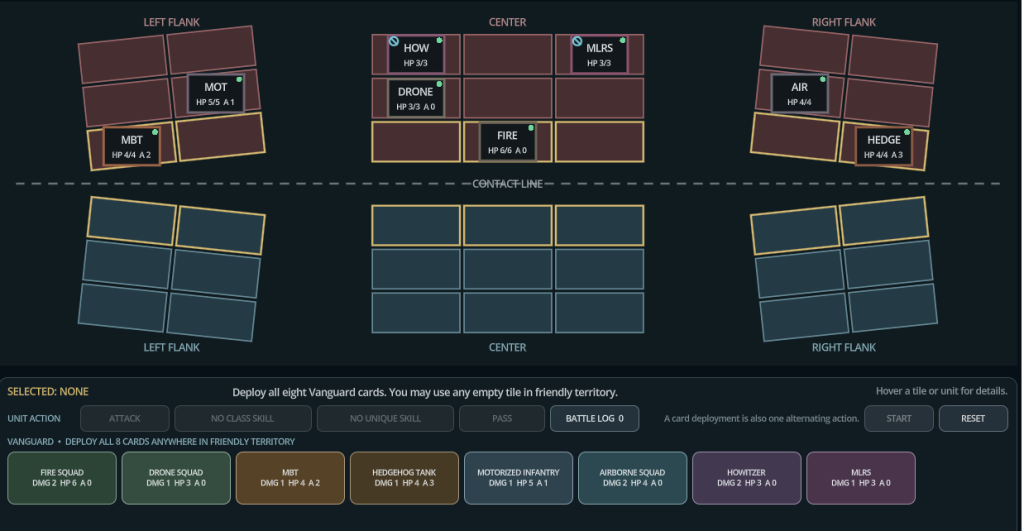
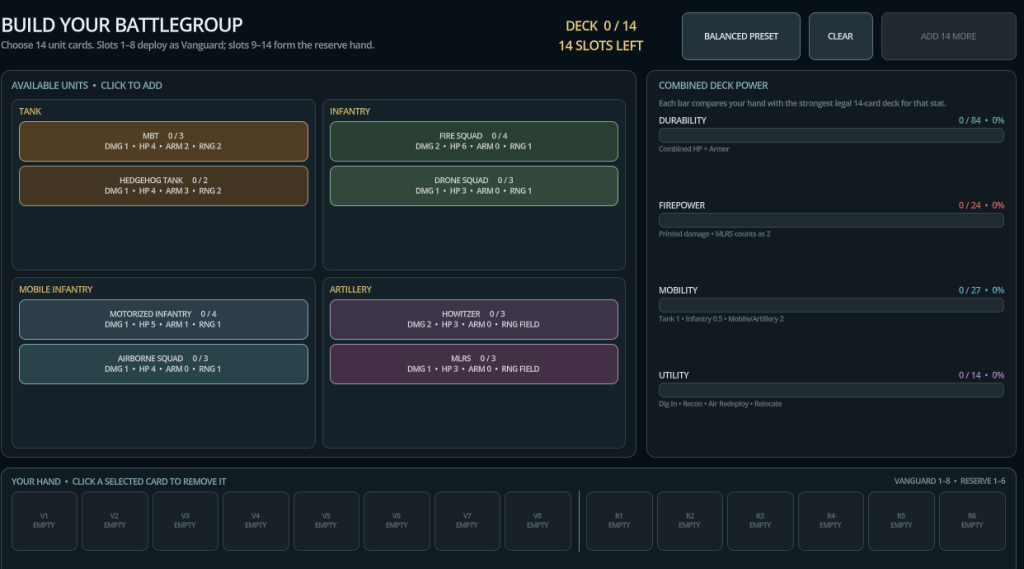
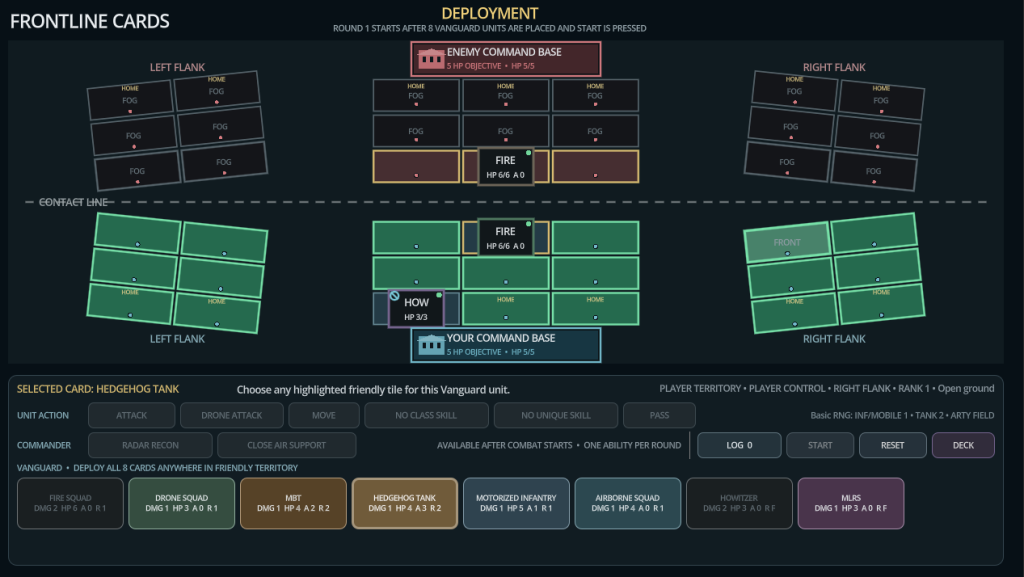
Before battle, the player assembles a fourteen-card deck (sometimes more) from infantry, tanks, mobile infantry and artillery. During battle, those cards enter a reserve and can be deployed onto the field. Once deployed, they remain there as units with health, armor, position, attack range and individual abilities. They are not discarded after producing one effect.
The battlefield is deliberately compact: three connected sectors — two flanks and a larger center. Small enough to stay readable, big enough for local breakthroughs, defensive lines, flanking attacks and moving forces between parts of the battle.
Both sides act in alternation. Instead of moving an entire army while the opponent waits, one side performs a single action and immediately hands control over. Moving a unit, firing artillery, deploying reinforcements or using an ability gives the enemy an opportunity to respond. The rhythm ends up closer to chess than to a traditional phase-based wargame or card game.
Position matters, too. Tiles change control as units move across them, and position determines where reinforcements can arrive. Pushing into the enemy’s rear can cut off their ability to deploy new forces in a sector entirely. Destroying the army is not the only path to victory: a successful breakthrough can collapse a defensive position even while enemy units remain elsewhere on the field.
Every class approaches this differently. Infantry holds ground and can dig into defensive positions. Drone teams reveal hidden areas and attack exposed targets. Motorized and airborne troops rapidly move between sectors and hit flanks hard. Tanks create and exploit breakthroughs, while artillery delivers long-range fire from concealed rear positions.
Fog of war, reconnaissance and concealment are already functional. Nearby enemies reveal one another, drones can scan selected areas, and artillery exposes itself when it fires. Armor is also more than a second health bar: it reduces incoming damage but degrades when struck, so repeated attacks gradually strip protection from even a heavily armored target. Units can move across the field in various ways depending on their type, skills and situation on the battlefield.
There is no random elements in the game. Every unit has fixed values for damage, HP, armor and abilities. So you can never blame your loss on the dice roll.
Where development stands now
The core combat loop is playable. I can build a deck, begin a complete battle and fight an AI-controlled opponent until one side is annihilated or its base is captured. Movement, deployment, reinforcements, attacks, armor, fog of war, concealment, reconnaissance, artillery barrages, unit abilities, sector breakthroughs and cross-sector movement are all implemented.
The eight current unit variants have distinct battlefield functions, and the deck-building screen enforces both the overall deck size and limits for individual unit types. Basic menus, resolution settings, music and sound controls are also working.
The AI has been one of the more entertaining parts of development. At various points it has attempted to bombard empty ground, moved a tank when attacking was obviously better, and demonstrated suspicious knowledge of units hidden behind fog of war. Fixing those mistakes gradually turned it from a tool for testing buttons into something capable of punishing bad play. The day it defeated me for the first time, I was genuinely happy — my game would have real challenge!
The project has moved beyond the initial prototype stage. That does not mean it is close to release. Much of the interface remains temporary, balance will change many times, the battlefield still needs proper terrain and visual presentation, and the campaign currently exists as a detailed design rather than a fully implemented sequence of missions. I also plan to add plenty of unique units for each commander and for the enemies.
But the foundation is there.
What comes next
The next major technical step is a general scenario system for the story campaign. Twenty-something missions should not feel like twenty variations of “destroy every enemy.” They will include sieges, survival battles, reconnaissance operations, encirclements, fighting withdrawals, rescue objectives, casualty limits and scripted changes to the battlefield.
Narrative scenes will appear before and after missions in visual-novel format. During combat, commanders will communicate through radio messages, react to battlefield events and sometimes intervene with their own command abilities. Story events must have mechanical consequences: if artillery runs out of ammunition, it disappears from the battlefield; if another commander promises support, that support should actually arrive; and if high command issues a catastrophic order, the player is forced to deal with it.
Next on the list is expanding the terrain system with features such as forests and high ground, continuing AI improvements, refining deck balance, and replacing the current placeholder presentation with the game’s intended military-anime visual style.
The immediate goal is a polished vertical slice from the opening part of the campaign: enough to introduce the world, teach the core mechanics and demonstrate how battles and character-driven storytelling work together. From there, the aim is a complete campaign, doing everything I can on my own. As I already mentioned, this unfortunately doesn’t include art. So if the project doesn’t fall apart and I’m satisfied with how it plays, I’ll go and beg other people to help me finish it. Sound designers, artists, musicians… God, I’m honestly scared of how much it will cost me in the end.
This experience is new to me, but I have a clear vision for the game and I pray I’ll have the ability, knowledge and plain stubbornness to persist.
So, yeah. Catgirls rule!